

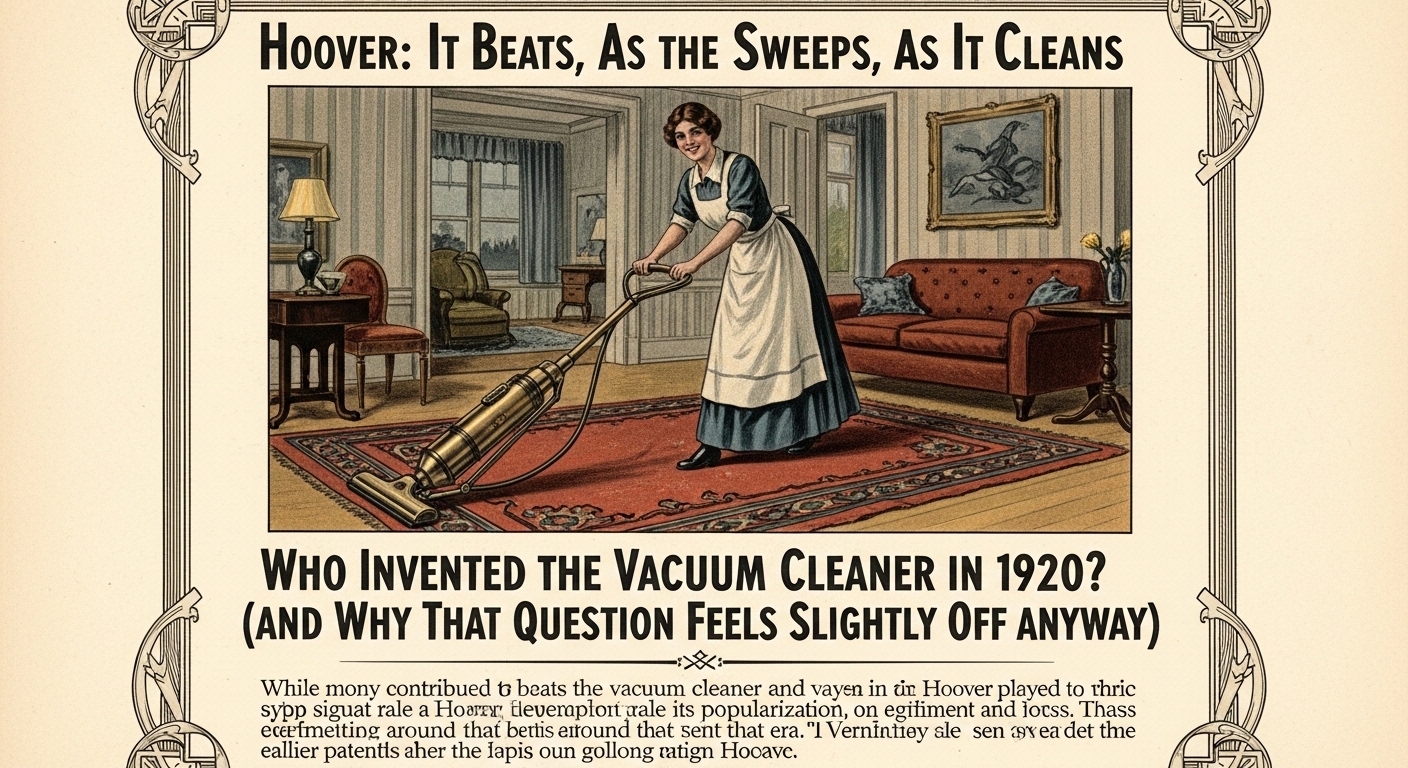
You’ve probably typed or muttered “who invented the vacuum cleaner in 1920” because something about the timeline just feels… fuzzy, like you’re almost remembering it right but not quite, yeah? And honestly, you’re not alone, a lot of ppl land right there, thinking 1920 must be the moment the whole thing began, when in reality it’s more like… that was when things got properly busy, not when they started.
So let’s untangle it, not in a stiff textbook way, but like we’re actually figuring it out together.
The Short Answer (That Isn’t Really Short)
If you’re looking for a clean name tied strictly to 1920, you’re gonna be a bit dissapointed, because the vacuum cleaner wasn’t invented in that exact year. Instead, what happened around the 1920s was more like a boom period, when earlier inventions finally became practical, electric, and kinda normal in homes.
Still, the key figures you should know are:
- Hubert Cecil Booth – built one of the first powered vacuum cleaners (1901)
- James Murray Spangler – created a portable electric vacuum (1907)
- William Henry Hoover – turned Spangler’s idea into a household name
So yeah, 1920 wasn’t the invention moment, it was more like the “okay now everyone kinda wants one” moment.
Why People Think the Vacuum Cleaner Was Invented in 1920
There’s actually a pretty understandable reason for this confusion, it’s not random.
Around the 1920s:
- Electricity became more common in homes
- Manufacturing improved (stuff got cheaper-ish)
- Branding and advertising exploded
- Companies like Hoover went big
So people didn’t see vacuum cleaners much before that, even though they existed. It’s like smartphones existed before the iPhone, but nobody really cared till they suddenly did, you know?
A Quick Timeline (Because Your Brain Probably Wants One)
| Year | What Happened |
|---|---|
| 1860s | Manual carpet sweepers appear |
| 1901 | Booth builds a motorized vacuum |
| 1907 | Spangler invents portable electric vacuum |
| 1908+ | Hoover starts selling improved versions |
| 1920s | Mass adoption begins |
Notice how 1920 is not the start, but it kinda feels like one.
The Real Origins of the Vacuum Cleaner
Hubert Cecil Booth – The Guy Who Thought “What If We Suck Instead of Blow?”
Back in 1901, Booth watched a machine that tried to clean by blowing dust away, which honestly sounds like the worst idea ever once you think about it for more than 3 seconds. He reportedly tested suction by putting his mouth on a chair and seeing if dust stuck to a handkerchief. Which is… kinda gross, but also kinda brilliant.
His machines were:
- Huge
- Horse-drawn (yes really)
- Parked outside buildings
- Connected by long hoses
So yeah, not exactly something you’d casually use in your living room while thinking about dinner.
James Murray Spangler – The Accidental Genius
Spangler wasn’t some big industrial engineer, he was actually a janitor with asthma, which makes the story feel more real somehow. He needed a way to clean without choking on dust, so he built a device using:
- A fan motor
- A soap box
- A pillowcase (as a dust bag)
Messy? Yes. Effective? Also yes.
This was around 1907, and this design is basically the blueprint for modern vacuums.
William Henry Hoover – The Business Brain
Now here’s where things shift. Hoover didn’t invent the vacuum cleaner, but he saw Spangler’s invention and thought, “this could sell.” He bought the patent and improved the design.
Some upgrades included:
- Better suction systems
- Replaceable dust bags
- More durable construction
By the 1920s, Hoover had turned vacuum cleaners into something people actually recognized, not just weird machines for rich ppl or businesses.
What Happened in the 1920s Specifically?
This is where your original keyword kinda clicks into place.
The 1920s were about:
1. Electrification
Homes started getting electricity more widely, especially in cities. Without power, electric vacuums are just… decorative lumps.
2. Consumer Culture Rising
People began caring about:
- Cleanliness standards
- Convenience
- Modern living
Owning a vacuum cleaner became less weird and more expected.
3. Advertising Got Loud
Companies ran campaigns that basically said:
“You’re not properly clean unless you vacuum.”
Which is a bit manipulative, but also effective.
4. Design Improvements
Vacuum cleaners became:
- Smaller
- Easier to use
- More affordable
Not cheap exactly, but reachable.
So Who Really “Invented” It?
If you’re trying to answer the question cleanly (which is kinda ironic given the topic), here’s how it breaks down:
- First powered vacuum: Booth
- First practical electric vacuum: Spangler
- First mass-market success: Hoover
So the invention wasn’t one moment, it was more like a relay race where each person passed the idea forward.
What Early Vacuum Cleaners Were Actually Like
You might be imagining something slightly clunky but still recognizable. That’s… optimistic.
Early versions were:
- Loud enough to scare pets (and probably neighbors)
- Heavy, sometimes requiring multiple people
- Not always reliable
- Occasionally dangerous (electric stuff was still new-ish)
And yet, people still saw them as futuristic, which says a lot about how annoying dust must’ve been back then.
A Few Odd Details You Probably Didn’t Expect
These are the bits that make the history feel less dry and more human.
- Booth’s machines required operators in uniforms, like a whole service
- Early vacuuming was sometimes a paid service, not a DIY chore
- Some people were scared of the machines, thinking they were unsafe
- The word “Hoover” became a verb in some countries, like saying “I’ll google it”
Language just does that sometimes, it grabs onto brands and refuses to let go.
Why This Still Matters (Even If It Feels Random)
You might be thinking, okay cool history lesson but why should I care who invented the vacuum cleaner in 1920 or whenever it actually happened?
Fair question.
Because it shows how inventions actually work:
- They’re rarely created in one moment
- They evolve through multiple people
- Adoption matters as much as invention
It’s not just about who made it first, it’s about who made it usable.
Vacuum Cleaners Today vs Then
Just to give you a sense of how far things have moved, here’s a quick comparison:
| Feature | Early 1900s | Today |
|---|---|---|
| Size | Huge | Compact |
| Power Source | External or basic electric | Advanced electric, battery |
| Filtration | Basic cloth bags | HEPA filters |
| Mobility | Limited | Cordless, robotic |
| Noise | Very loud | Still loud… but better |
And yeah, modern ones still somehow manage to be annoying, just in different ways.
Final Thoughts (Without Pretending This Was Ever Simple)
So when you ask who invented the vacuum cleaner in 1920, what you’re really touching on is a moment when the invention became visible, not when it was born. The real story is messier, stretched across years and people and weird little experiments like sucking dust through a handkerchief.
If you remember anything from this, let it be this slightly awkward truth: inventions don’t arrive cleanly, they sort of… gather themselves over time, like dust in a corner you didn’t notice until suddenly you really did.
And yeah, kinda fitting for a vacuum cleaner story, isn’t it.