

You ever stop and think, like really think, about who invented vacuum cleaner? I mean, you’re zipping around your living room, humming along, and suddenly you’re like, “Who even thought up this contraption that slurps dust like it’s no big deal?” And let me tell ya, the story is kinda messy, like a tangled extension cord under your couch, but it’s also full of weird twists and random inventors nobody ever talks about.
The Messy Origins of the Vacuum
Most people think James Murray Spangler is the guy behind the vacuum, and well… he kinda is. But, before him, there were folks trying all sorts of weird ways to get dirt off carpets. In the late 1800s, you had contraptions that looked more like giant metal canisters with hand pumps than anything we’d call a vacuum today. Imagine lugging one of those things around your parlor while trying to not break a lamp.
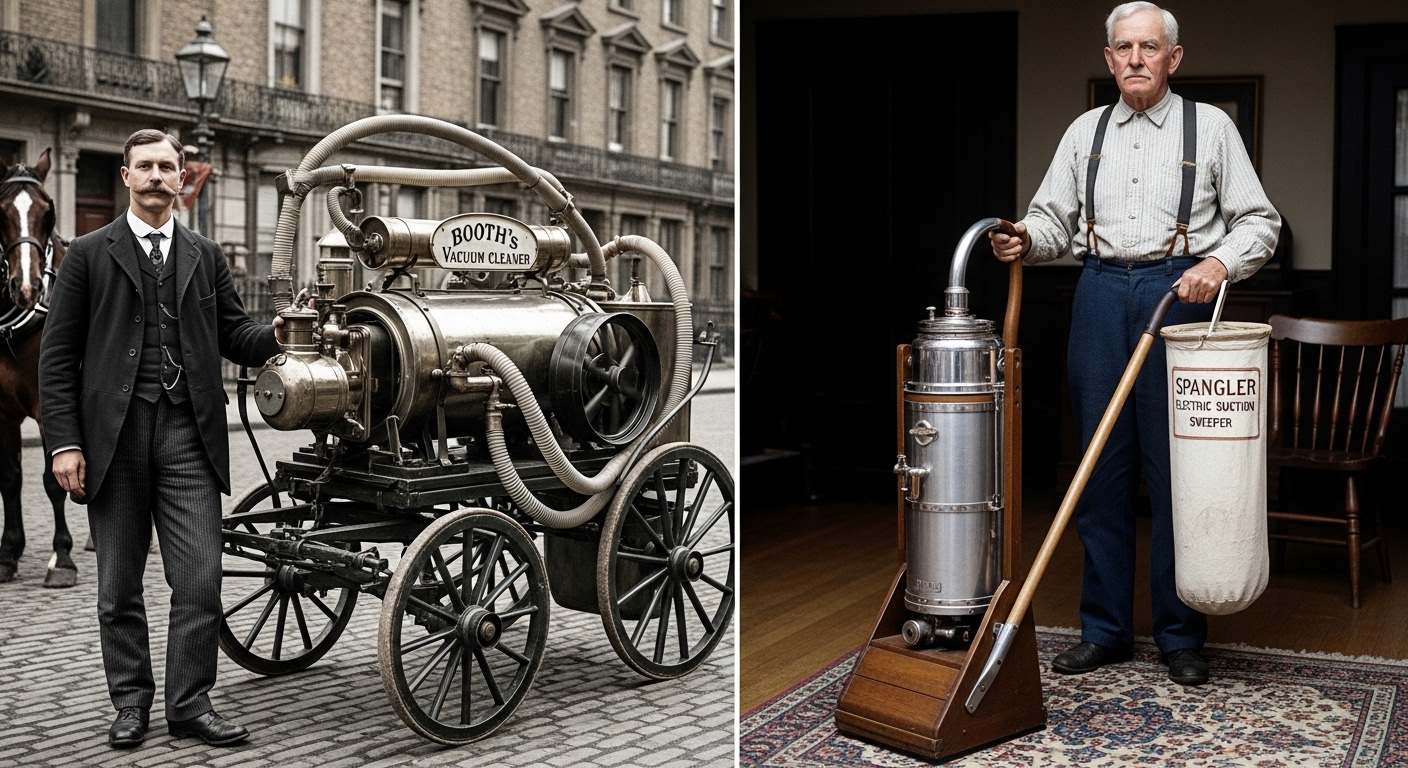
Spangler, by the way, was a janitor in Cleveland, and legend says he had asthma. He was annoyed with all the dust making him wheeze, so he cobbled together a motor, a fan, a soapbox, and a pillowcase. Yeah, a pillowcase. And boom—the first practical electric vacuum cleaner was sorta born in 1907. The funny thing is, he didn’t get rich off it right away. He sold the patent to his cousin-in-law, William Hoover, who then kinda turned it into the vacuum empire we know today.
But before Spangler, people like Hubert Cecil Booth in London were tinkering with sucking dust using massive machines. Booth’s version in 1901 was basically a horse-drawn monster that had to stay outside the building while long hoses snaked in to clean floors. Can you imagine that? Calling it the first “mobile vacuum” might be generous.
The Hoover Effect
You can’t talk about who invented vacuum cleaner without talking Hoover. William Hoover, who was originally a leather-goods manufacturer, saw Spangler’s invention and went, “yep, I can make this big.” He improved the design, marketed it aggressively, and basically created the household vacuum as a thing you actually wanted in your house. By the 1920s, owning a Hoover was like a status symbol in America. People didn’t just buy a vacuum; they bought a promise that their floors were now magically dust-free.
Interestingly, Hoover didn’t just stop at pushing the product. They made commercials, offered free demonstrations, and even trained door-to-door salespeople. Kinda wild when you think about it now, considering we just scroll and buy stuff online. But it worked. Hoover’s approach basically stamped the vacuum as a necessity instead of a weird gadget.
The Early Designs You Probably Haven’t Seen
Here’s where it gets kind of funny. The vacuums before Spangler weren’t exactly… graceful. Some ran on hand cranks, some used compressed air, and some even required you to sit on top of a machine to make it work. There’s one model that literally had to be pulled by horses around a football field-sized carpet just to clean one room. People back then had some serious patience, or maybe they just hated dust a lot more than we do.
Here’s a little table for fun:
| Inventor | Year | Design Notes | Limitations |
|---|---|---|---|
| Hubert Cecil Booth | 1901 | Massive horse-drawn suction | Had to stay outside the building |
| Daniel Hess | 1860 | Carpet sweeper with bellows | Manual, very labor-intensive |
| James Murray Spangler | 1907 | Electric motor, fan, pillowcase bag | Initially small-scale, needed patent sale |
| William Hoover | 1908+ | Improved design, mass production | Expensive at first |
This table barely scratches the surface, but it’s kinda wild to see how many versions existed before we got the vacuum that just… works.
Fun Facts You Might Not Know
- Spangler actually got $0.50 a week royalty when Hoover started selling the vacuums. That’s… not even a latte a week today.
- Booth’s giant vacuum was so loud people complained it sounded like an engine ready to explode.
- The first home vacuum with wheels didn’t appear until the 1920s. Before that, people had to drag or carry the thing.
Here’s a quote from Booth himself: “It seems to me that a device that can remove dust entirely from a carpet without stirring it up is a necessity, not a luxury.” Pretty forward-thinking for a guy who literally made a vacuum bigger than most modern living rooms.
How the Vacuum Changed Housekeeping
Think about your life right now. You probably spend minutes, maybe an hour, vacuuming a week. But in the early 20th century, this was a major chore involving sweating, heavy machinery, and lots of frustration. The invention of the electric vacuum actually changed domestic life. It gave households a faster, cleaner, and even somewhat healthier environment. Allergies were less of a problem for those who could afford one.
And don’t get me started on the ripple effects: cleaning services boomed, carpet manufacturers innovated, and even home layouts started considering how easy it’d be to vacuum around furniture. Weird to think that one invention could sneakily shape interior design trends.
Modern Vacuum Evolution
Since Hoover and Spangler, vacuums have gone bananas. You’ve got robots, cordless sticks, bagless wonders, and super-powered HEPA filters that claim they can suck up microscopic dust mites (gross, but yes, true). Some modern vacuums can even map your entire home, talk to your smart assistant, and avoid pets. Kinda crazy how far we’ve come from Spangler’s pillowcase prototype.
Here’s a small list of milestones in vacuum tech evolution:
- 1920s – First home vacuums with wheels
- 1930s – Introduction of beater bars to lift carpet fibers
- 1960s – Development of lightweight and portable models
- 1980s – Bagless vacuums enter the market
- 2000s – Robotic vacuums become commercially viable
Each step shows someone thinking, “okay, but how can we make it less annoying to use?” Because let’s be honest, no one wants a vacuum that fights back.
Wrapping Up the Dust Trail
So yeah, when you’re asking “who invented vacuum cleaner,” it’s not a simple one-name answer. It’s a bunch of curious minds, stubborn inventors, and a little bit of luck. Daniel Hess, Hubert Cecil Booth, James Murray Spangler, William Hoover—all of them added a piece to the puzzle that lets you clean your floor in under ten minutes. Next time you pull out your vacuum, maybe give a tiny nod to Spangler’s pillowcase or Booth’s horse-drawn monster. They made it all possible, and honestly, they probably had a lot more fun—or at least frustration—than you do.
Understanding the history isn’t just trivia. It makes you appreciate that every hum, whirr, and brush roll has decades of tinkering behind it. And now, knowing this messy, convoluted, kinda chaotic story, you can see the vacuum not just as a cleaning tool, but as a piece of human ingenuity that went from giant machines outside your house to the sleek little noise-makers we love to complain about today.
Would you like me to create a catchy meta description and SEO snippet for this blog too? It can really help it rank better.