

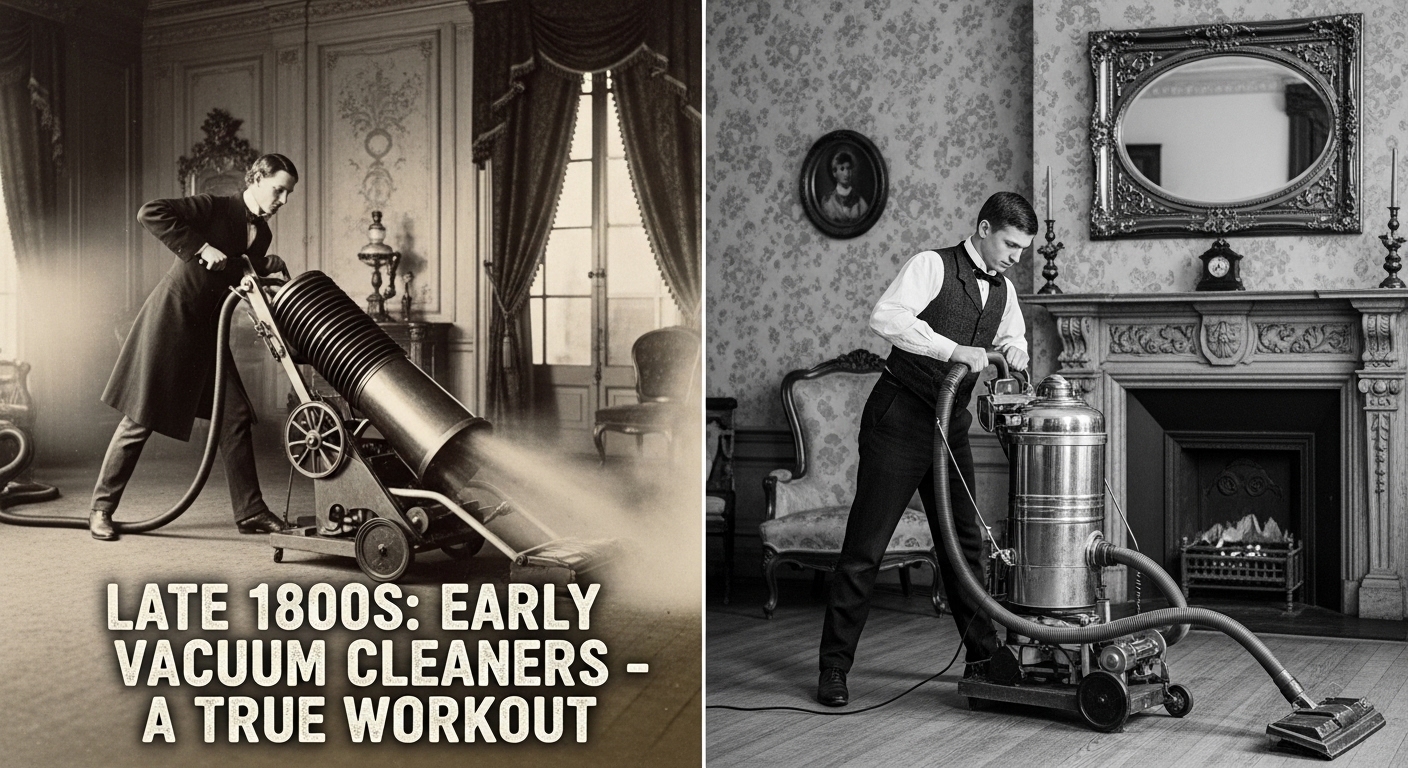
You’ve probably muttered “when was the vacuum cleaner invented” at least once while dragging that loud thing across the floor, wondering who decided cleaning should sound like a jet taking off in your living room. And yeah, fair question, because it kinda feels like this machine showed up both too early and too late at the same time.
Let’s untangle it properly, but not in that stiff textbook way, more like you and me figuring it out over tea, slightly distracted but curious enough to keep going.
So… When Was the Vacuum Cleaner Invented, Actually?
The honest answer is: it depends what you mean by “vacuum cleaner,” and that’s where things get a bit messy, not unlike your carpet before cleaning it.
- The first rough idea showed up in 1860
- A more recognizable version came in 1901
- The kind you’d actually want in your house? That took a bit longer
So yeah, no single moment where someone went “boom, vacuum cleaner done.” It was more like a slow, slightly awkward evolution, like early smartphones but with more dust.
The First Attempt (1860) – Not Exactly Convenient
In 1860, an American inventor named Daniel Hess created something that people often call the first vacuum cleaner. But if you’re imagining plugging something in and zooming around your room, nope, not even close.
His machine used:
- Rotating brushes
- Bellows (basically like squeezing air manually)
- No electricity (obviously, since electricity wasn’t exactly mainstream yet)
You had to operate it by hand. Which kinda defeats the purpose, right? Cleaning while also doing a mini workout. Not ideal.
Still, it introduced a big idea: using suction to remove dust, even if the execution was… well, questionable.
The “Horse-Drawn Vacuum” Era (Yes, Really)
Now this part sounds made up, but it isn’t.
By the late 1800s, inventors were experimenting more seriously. One guy, Hubert Cecil Booth, had a realization in 1901 after seeing a machine that blew dust off surfaces instead of sucking it in.
He thought, “why not reverse that?”
And just like that, suction became the main character.
Booth’s 1901 Machine
- Powered by an engine
- Too large to fit inside houses
- Mounted on a horse-drawn carriage
Yeah, so instead of bringing the vacuum to the dirt, you brought your house to the vacuum. Or more accurately, parked the machine outside and ran hoses through windows.
Imagine explaining that to someone today. “Yeah just wait, the vacuum truck is coming.”
Still, this is widely considered the first true vacuum cleaner, because it actually used powered suction in a meaningful way.
When Vacuum Cleaners Entered Homes (Finally)
Things started to feel more familiar in the early 1900s.
1907 – The Game Changer
A janitor named James Murray Spangler invented a portable electric vacuum cleaner. And honestly, this is where things start looking like what you’d recognize today.
His design included:
- A motor (borrowed from a fan)
- A rotating brush
- A pillowcase used as a dust bag (not fancy, but it worked)
It wasn’t perfect, but it was practical. And practicality is what finally made vacuum cleaners… stick.
Now here’s a twist that feels almost cinematic.
Spangler couldn’t really commercialize his invention, so he sold the patent to his cousin’s husband.
That man? William Henry Hoover.
Yes, that Hoover.
Why “Hoovering” Became a Verb
In many places, especially the UK, people don’t say “vacuuming,” they say “hoovering.” That’s how dominant Hoover became.
What Hoover Did Differently
- Improved the design
- Made it more user-friendly
- Marketed it aggressively
They even offered free home trials, which at the time was a genius move. People got to try the machine in their own messy homes, and once they saw how much dirt came out… well, they were sold.
There’s something deeply convincing about seeing your own dust get exposed like that.
Evolution of Vacuum Cleaners Over Time
The invention didn’t stop in 1907, obviously. It kept evolving in ways that kinda reflect how we live.
Key Milestones
| Year | Development | Why It Mattered |
|---|---|---|
| 1920s | Smaller, portable models | More homes could afford them |
| 1950s | Upright vacuums became popular | Easier to store and use |
| 1980s | Bagless designs introduced | Less hassle, more visibility |
| 2000s | Robotic vacuums | Cleaning without doing anything (finally) |
Each step solved a problem, but also introduced new annoyances. Like bagless vacuums being great until you empty them and accidentally create a dust cloud. Not fun.
The Psychology of Clean Floors (Weird but True)
This might sound slightly off-topic, but it isn’t really.
Vacuum cleaners didn’t just change cleaning, they changed how people felt about cleanliness.
Before vacuums:
- Dust was kind of… accepted
- Cleaning was labor-intensive
- Floors weren’t expected to be spotless
After vacuums:
- Clean floors became a standard
- People started noticing dirt more
- There was a subtle pressure to maintain hygiene
It’s funny, because the invention solved a problem and also created a new expectation. You could argue it made life easier, but also a bit more demanding.
Types of Vacuum Cleaners You See Today
You’ve got options now, probably too many if we’re being honest.
Common Types
- Upright Vacuums
Good for large carpeted areas, but can feel bulky. - Canister Vacuums
More flexible, slightly annoying to drag around. - Stick Vacuums
Lightweight, convenient, but sometimes underpowered. - Robot Vacuums
Lazy person’s dream, until it gets stuck under a chair. - Handheld Vacuums
Great for quick messes, not so much for full cleaning.
Each type is basically a response to lifestyle changes. Smaller homes, busier schedules, less patience for dragging cords around.
Fun (and Slightly Odd) Facts About Vacuum Cleaners
Just to keep things interesting, here are a few things people don’t usually talk about:
- Early vacuum cleaners were so loud they scared pets (and probably humans too)
- Some early models required multiple operators
- The first users were mostly wealthy households
- Vacuum cleaners were once seen as a luxury status symbol
And honestly, that last one feels strange now. Imagine bragging about your vacuum cleaner at a dinner party.
Then again… some people still do.
Why It Took So Long to Get It Right
If you’re still thinking about “when was the vacuum cleaner invented,” the deeper answer is this:
It wasn’t just about inventing it. It was about making it usable.
There were a few big challenges:
1. Power Sources
Early machines didn’t have reliable electricity, so they relied on:
- Manual effort
- Steam engines
- Gas-powered systems
Not exactly convenient for a living room.
2. Size and Weight
Early vacuums were massive. Like, “this belongs in a factory” massive.
3. Cost
Only wealthy people could afford early models. Mass production took time.
4. Design
It took years to figure out:
- Proper suction systems
- Dust storage (bags vs bagless)
- Ease of movement
So yeah, it wasn’t just one invention. It was a long series of “almost there” moments.
A Quote That Still Feels Relevant
Hubert Cecil Booth once reportedly said something along the lines of:
“Why not clean by suction?”
It sounds simple, almost obvious. But at the time, it wasn’t.
That’s kinda how innovation works sometimes. The idea feels obvious after someone says it.
The Real Answer, If You Had to Pick One
If someone insists on a single answer to “when was the vacuum cleaner invented,” you could say:
- 1860 for the first concept
- 1901 for the first powered suction machine
- 1907 for the first practical home vacuum
But honestly, the best answer is: it was invented gradually, over decades, by people who probably didn’t realize how much they were changing everyday life.
Why This Still Matters (Even If You Hate Vacuuming)
You might not care about the history while you’re cleaning under the couch, but there’s something oddly satisfying about knowing how far things have come.
From:
- Hand-powered contraptions
to - Horse-drawn machines
to - Smart robots mapping your house
That’s a pretty wild journey for something designed to pick up dust.
And maybe next time you’re vacuuming, you’ll think about that, just for a second, before getting annoyed again.
Or maybe not, which is fair too.