

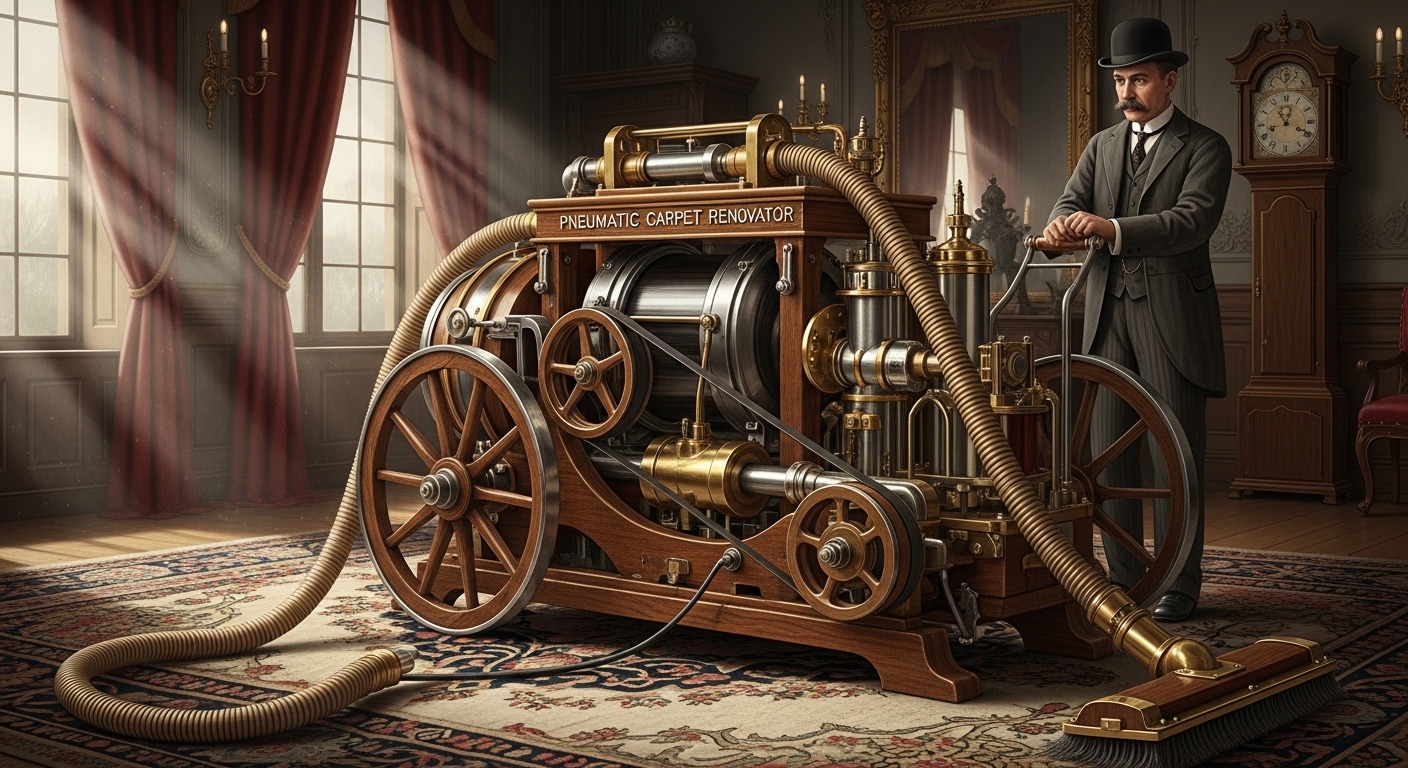
You ever find yourself staring at that dusty corner under your couch and thinkin’, “man, wonder how folks ever cleaned this before vacuums?” Yeah, me too. And it kinda makes ya curious—what was the first vacuum cleaner like anyway? Like, who thought, “hey, let’s make a machine that suctions dirt like a hungry little monster”? Turns out, the history is way quirkier than you’d think, and it wasn’t always the smooth rollin’ vacuum we wheel around today.
The Early Days: Suction Dreams
So, the first vacuum cleaner wasn’t electric. Surprise, right? We’re talkin’ mid-19th century, when folks were still sweepin’ rugs with brooms and dustpans that made your arms ache in like five minutes. The earliest version people kinda agree on was made by a dude named Daniel Hess in 1860 in the US. His thing looked more like a weird barrel with a hand-crank and bellows attached. You had to pump it manually to suck up dust, and it even had a cloth filter inside to catch all the gunk. Imagine tryin’ to vacuum your whole living room with that thing—exhausting!
Then in 1901, another chap named Hubert Cecil Booth in England took it up a notch. Booth’s machine was huge. I mean, massive. It was so big they had to park it outside the building and run long hoses in through the windows. Booth actually got the idea after watching a demonstration where a machine blew dust around rather than sucked it up. He figured, why not reverse it? That’s kinda the spark that gave us the first commercially practical vacuum cleaner, and people called it the “Puffing Billy,” though some sources say that was a nickname.
The Mechanics of Early Suction
If you think about it, the first vacuum cleaner mechanics were wild. You didn’t just plug it in. Nope. Booth’s version used an engine—sometimes gasoline-powered—to create suction. A long hose carried the airflow, and then a filter bag inside caught the dust. No fancy HEPA filters, no attachments for corners, nothing. Just raw suction.
Here’s a quick peek at the evolution of mechanics in those early vacuums:
| Year | Inventor | Type | Power Source | Notes |
|---|---|---|---|---|
| 1860 | Daniel Hess | Manual bellows | Hand-crank | Used rotating brushes and filter bags |
| 1901 | Hubert Cecil Booth | Stationary suction | Gas engine | Required hoses; could clean large buildings |
| 1907 | James Spangler | Portable | Electric motor | Inspired the modern upright vacuum |
James Spangler, by the way, is the guy who basically gave us the upright vacuum idea. He was a janitor, sick of dust causing him sneezes and all sorts of allergies, so he cobbled together a broom handle, a soapbox, and a pillowcase for a dust bag, added an electric fan motor, and boom—one of the first portable vacuum cleaners. Fun fact: he sold the patent to William Hoover, and yeah, that’s the Hoover brand we still think of when we say “vacuum cleaner.”
Did You Know? Some Crazy Stats
Back in Booth’s day, the vacuum wasn’t for home use at first. He mainly sold them to hotels and theaters. Cleaning a theater carpet? Could take a team of operators hours. By contrast, Spangler’s design in the 1900s could let an average household tackle dust in under an hour. Imagine the relief.
Also, check this: by 1920, Hoover had sold around 2,000 units. Sounds tiny today, but back then it was revolutionary. Households were just starting to embrace electricity, and now they could have this gadget that didn’t make them sweat buckets like broom-sweeping marathons.
How the First Vacuum Changed Life
Thinkin’ about the first vacuum cleaner isn’t just historical trivia—it’s kinda wild how it shaped domestic life. Before vacuums, cleaning was brutal. Housewives (mostly women, thanks to societal norms back then) spent hours dustin’, sweepin’, sometimes beatin’ rugs with sticks outside. After vacuums, dusting became faster, more efficient, and even safer for allergies (well, eventually with better filters).
Booth’s huge machines also influenced industrial cleaning. Factories, office buildings, theaters—suddenly, they could maintain cleanliness on a scale that was impossible before. And even the design principles from Booth and Spangler—suction, airflow, dust containment—still influence modern vacuum tech. Every Dyson, Shark, or even robotic Roomba carries a DNA link to these early contraptions.
Evolution Over the Years
So the first vacuum cleaner was basically a giant experiment that got smaller, more practical, and way more user-friendly. After Hoover popularized the upright, companies started adding:
- Motorized brushes for carpets
- Detachable hoses for nooks and crannies
- Improved filters to trap microscopic dust
- Lightweight designs so granny could carry it upstairs without breaking her back
By the 1950s, vacuums became household staples. And today? We got cordless, robotic, self-emptying wonders. It’s kinda crazy when you trace it all back to that 1860 hand-crank bellows. You can almost hear Daniel Hess going, “this is gonna make folks lazy in a good way.”
Why You Might Care About This
You might be thinkin’, “okay, but why should I care about some old vacuum?” Well, history has a sneaky way of showing us how human innovation solves everyday annoyances. Dust is universal, sneezes are universal, and the desire to clean efficiently is, apparently, eternal. Also, it’s kinda fun to know your Roomba has ancestors that looked more like a small cannon with hoses than the sleek machines you glide across your living room floor today.
Key Takeaways
- The first vacuum cleaner was manual and looked more like a contraption than a household appliance.
- Hubert Cecil Booth revolutionized suction and filtration with huge stationary machines.
- James Spangler’s electric design paved the way for the portable vacuum we know.
- The vacuum drastically changed domestic life and industrial cleaning.
- Every modern vacuum, even fancy robot ones, owes something to these early inventions.
In the end, when you’re pushin’ your vacuum under the couch and it makes that satisfying roar, just think of the hundreds of dusty corners cleaned by clunky bellows and gasoline engines before it. The first vacuum cleaner wasn’t just a machine—it was a messy, noisy leap toward cleaner, easier living. And it’s kinda neat to imagine all those early inventors sneezing through their experiments while dreamin’ up a cleaner world for everyone.
History ain’t always neat, but sometimes the dustiest stories are the most fascinating, and the story of the first vacuum cleaner is definitely one of those.