

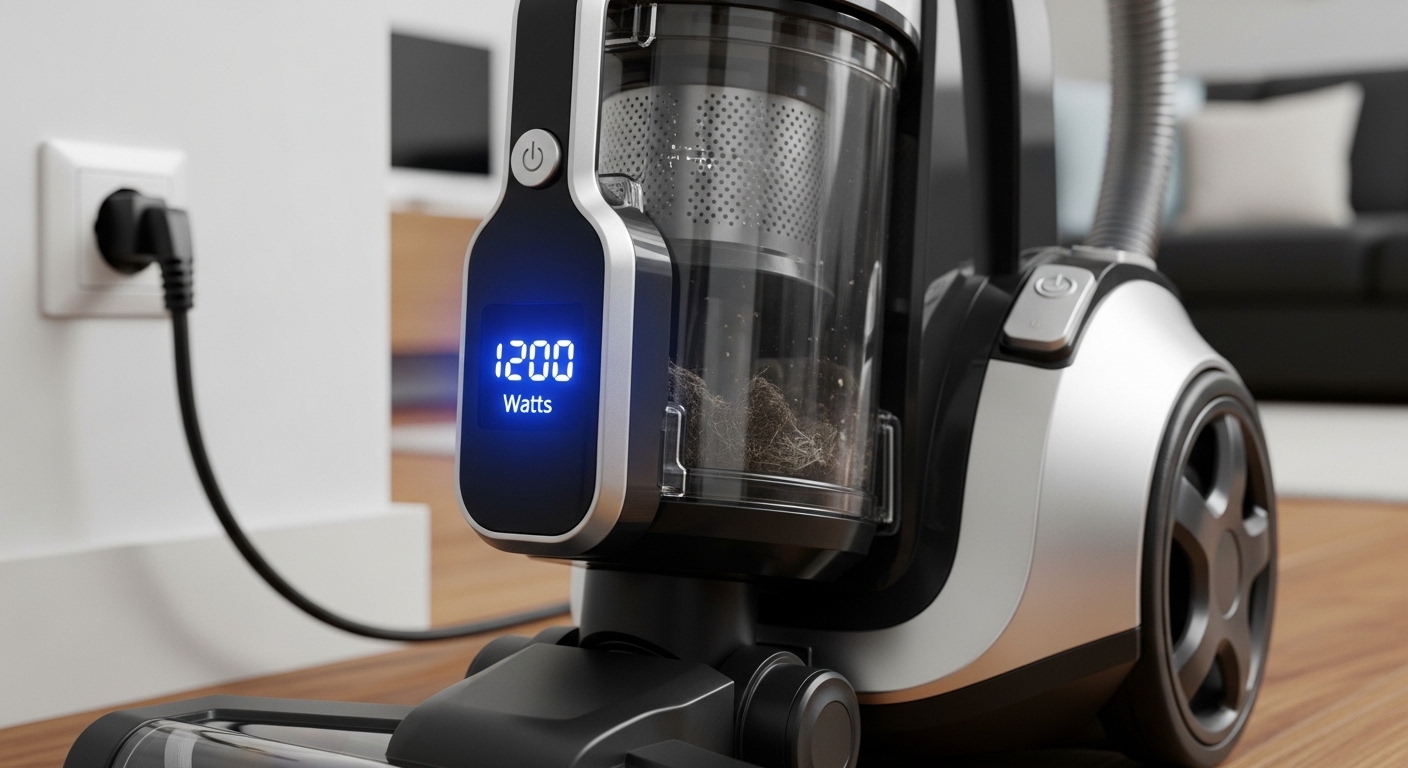
You ever been in the middle of cleaning your living room, looking at your vacuum cleaner, and thought, “wait… how many watts is this thing really using?” Yeah, me too. It’s funny cuz on one hand, it’s just a vacuum, right? But then you start thinking about electricity bills, suction power, and all that technical mumbo-jumbo, and suddenly it feels like you’re staring at an alien spaceship control panel. So let’s just unpack this mess in a way that doesn’t make your brain hurt.
Understanding Vacuum Cleaner Power Without the Headache
Most vacuum cleaners you find in homes today usually hover somewhere between 500 watts and 3000 watts. Yup, that’s a pretty wide range, and it really depends on what type of vacuum we’re talkin’ about. Stick vacuums? Usually on the lower end, around 500-800 watts. Full-sized upright models? They’re in the 1000-2000 watt ballpark, sometimes more. Canister vacs tend to sit in the same region but can vary more depending on the motor.
Now, here’s the kicker: more watts doesn’t always mean better cleaning. A lotta people get caught up thinking higher wattage = stronger suction. But the reality is a bit more nuanced. Suction efficiency, airflow design, brushroll effectiveness—all of this contributes just as much, sometimes even more, than the raw watts.
Wattage vs Suction: What You Should Actually Care About
If you ever peek at your vacuum’s label, you’ll see something like “1200W” printed there, and think, wow, that’s a lot. But what does that really tell ya? Wattage is just how much power the motor is consuming from your outlet. It doesn’t exactly tell you how much dirt it’s picking up.
Suction power is measured in air watts (AW), which is kinda like the vacuum equivalent of horsepower in cars. For example, a vacuum might consume 2000 watts of electricity but only produce 250 air watts of suction. That 250 AW is what’s actually doing the cleaning. So, don’t just chase the biggest number on the box—look for reviews, real-world tests, and airflow performance.
Average Watts by Vacuum Type
| Vacuum Type | Typical Wattage Range | Notes |
|---|---|---|
| Stick Vacuum | 500–800 W | Lightweight, less power, good for quick cleanups |
| Upright Vacuum | 1000–2000 W | Great for deep carpet cleaning, more energy-intensive |
| Canister Vacuum | 1200–2000 W | Balanced power, often quieter, versatile |
| Robot Vacuum | 30–90 W | Tiny motors, low energy, limited suction |
| Handheld Vacuum | 100–300 W | Portable, spot cleaning, low wattage |
See how robot vacuums barely use any watts? But they can still keep your floors reasonably clean if you’re okay with smaller dust pickup.
Energy Bills and Wattage: Let’s Crunch Some Numbers
Ok, so you wanna know if running your vacuum is gonna blow up your electricity bill. Let’s do some quick math, don’t worry, it’s painless. Suppose your vacuum is 1500 watts (1.5 kW) and you use it for 30 minutes a day. That’s 0.75 kWh per day. Over a month, assuming 30 days, that’s 22.5 kWh. Depending on your local rates—let’s say $0.13 per kWh—that’s roughly $2.93 a month.
Not bad, huh? Even if you go nuts and vacuum every day, it’s really not gonna bankrupt you. But yes, bigger wattage vacuums suck more juice. So if you care about energy savings, maybe don’t pick a 3000W beast just for a studio apartment.
Why Some Vacuums Are Way Less Efficient Than Others
It’s not just about watts. Some vacuums waste a ton of energy because of bad design. A motor can be insanely powerful, but if the airflow is blocked or the brushroll is poorly aligned, you’ll get minimal cleaning for maximum electricity. Think of it like a sports car with a clogged exhaust—it burns fuel but doesn’t perform as it should.
Filtration matters too. HEPA filters are awesome for allergies but can restrict airflow if not cleaned regularly. That means your vacuum might be sucking like it’s powered by 500W when it’s actually a 1500W motor under the hood. So yeah, watts matter, but maintenance and design matter just as much.
Real-World Examples From Popular Brands
Let’s break down some real numbers from vacuums you might actually see in stores:
- Dyson V11 – Around 545W but produces impressive suction thanks to air-efficient design.
- Shark Navigator Lift-Away – 1200–1400W motor, handles carpets like a pro.
- Roomba i7+ – Only 33W, but it’s automated and perfect for light daily cleaning.
- Miele Complete C3 – 1200–1600W, super quiet, high airflow efficiency.
Notice something? The wattage alone doesn’t dictate the cleaning power. Dyson and Roomba show how smart engineering can get more cleaning done with less energy.
Tips for Picking a Vacuum Without Obsessing Over Watts
- Consider your flooring – Carpets need more suction, hardwood can get by with less.
- Check airflow & design – Look at brushroll efficiency and nozzle design.
- Don’t ignore portability – Lightweight vacuums might use fewer watts but save you muscle.
- Energy efficiency – Look for models that mention “optimized suction” rather than just high wattage.
- Maintenance matters – Clean filters and empty dustbins to keep watt usage meaningful.
Myths About Vacuum Wattage Debunked
- Myth 1: Higher watts = cleaner floors. Nope, you need to consider air watts, design, and brush type.
- Myth 2: Low-watt vacuums are useless. Not always, especially on hardwood and tiles.
- Myth 3: Energy-efficient vacuums are weak. Modern tech allows small motors to pack a punch.
Basically, wattage is just one piece of a bigger puzzle. Don’t let the number fool ya.
The Future: Wattage Trends in Vacuum Technology
Vacuum tech is slowly shifting toward efficiency. Cordless models are getting more suction with smaller motors. Smart vacuums are using AI navigation to cut runtime and energy usage. Even upright models are incorporating better airflow channels, so a 1200W motor can outperform an old 2000W model from ten years ago.
Manufacturers are realizing that people care about convenience, energy costs, and quiet operation just as much as raw power. That’s why today’s watt ratings are more about marketing than actual performance sometimes.
Wrapping It Up Without Losing Ya in Numbers
So how many watts is a vacuum cleaner? The answer is: it depends. From tiny 30W robots to beefy 3000W uprights, there’s a huge spectrum. But what really matters is how efficiently those watts translate into suction, how well the vacuum handles your floors, and how much hassle you have maintaining it.
Next time you’re staring at a vacuum box in the store, don’t freak out about the watts. Think about what you actually need for your floors, the kind of dirt you deal with, and how often you’ll use it. Watts give you part of the picture, but real-world performance is what’s gonna keep your carpets clean without blowing up your electric bill.
In the end, knowing how many watts your vacuum uses is kinda like knowing how many calories are in a snack—you gotta understand the context to see if it really matters. So yeah, next time someone asks you “how many watts is that vacuum?”, you can give ’em a smarter answer than just “a lot.” You can actually explain why it works the way it does, and maybe even save a bit of cash and energy along the way.
Would you like me to also make a catchy SEO meta description and subheadings for this post? It would help your blog rank higher on search engines.