

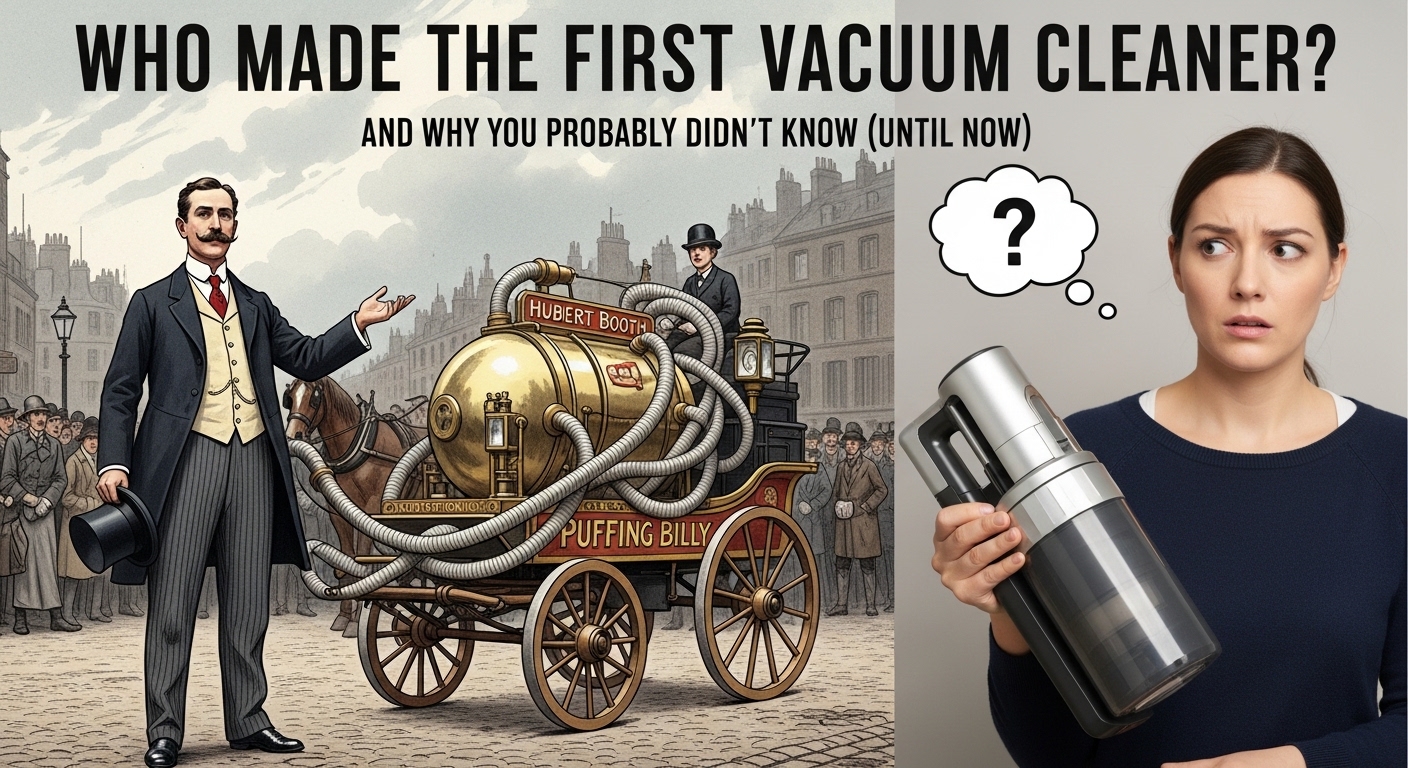
You know that weird moment when you’re staring at that old vacuum in your closet and wonder “who made the first vacuum cleaner that actually worked?” — yeah, you’ve totally been there, even if you never said it out loud. You’ve held that rigid hose, maybe even cursed at it when it didn’t suck up pet hair, and somewhere deep down you got curious about how this thing ever came to be. That’s exactly why we gotta talk about this — not the boring textbook stuff, but real story that feels like someone’s telling you over coffee.
Let’s be honest, most folks just know the vacuum cleaner as “that loud machine that eats dust.” But I want you to picture this with me: a time before even the hum of electricity was part of daily life — a period where cleaning floors was done by beating rugs or sweeping endlessly. Come on, imagine living in that world for a sec. I know, kinda maddening.
So let’s dive in, because you’re about to find out who made the first vacuum cleaner, how the struggle to clean was real and sweaty, and why this invention totally changed the day-to-day life of ordinary folks.
The Real Beginning: Early Attempts (Way Before Electricity)
You might assume the first vacuum cleaner came outta nowhere, like a sudden invention after electricity became common. But nope, people had been fiddling with suction ideas since the 1800s — before even most homes had light bulbs. The keyword here isn’t electric yet, it’s suction.
Here’s what went down:
- In the late 1860s, there was a man named Daniel Hess. Some people don’t even know his freakin’ name. This guy from the United States filed a patent in 1860 for something that looks kinda like a vacuum. It used bellows and brush attachments, and it was supposed to suck dust from carpets. But honestly, it was bulky, clumsy, and not practical in a regular house.
- Almost in the same era, a dude named Ives W. McGaffey gets credit for a manual suction machine called the Whirlwind in 1869. You literally had to pump it by hand — or boot — in order to make it draw up dust. People at the time called it a suction sweeper.
Now here’s the thing: even though these early models were cool-ish, they weren’t what most folks would consider a vacuum cleaner the way you know it today. But they were definitely seeds. Without them? No “first vacuum cleaner” as we think of it — electrical, portable, and actually useful.
So… Who Actually Made the First Vacuum Cleaner (Electric Version)?
Alright, here’s the part most people wanna know. The name most commonly credited with developing the first practical, portable vacuum cleaner is Hubert Cecil Booth. Let me tell you why Booth’s story is kinda wild.
In 1901 — yes, the early 1900s — Booth, a British engineer, was watching a demonstration of a machine that blew dust off chairs and trains using compressed air. Yeah… I know — blowing dust sounds like the dumbest idea ever when all you want is less dust. But Booth got this weird spark in his head: “What if we could suck dirt instead of just blowing it around?”
And that thought, that single little question, changed household cleaning forever.
Booth’s first vacuum was enormous. I mean huge — it was powered by a gasoline engine, so big in fact that it had to stay outside and be connected into buildings through long hoses. They called it the Puffing Billy. Not elegant, not cute, but functional. And it worked. People actually used it in factories and large buildings.
To break it down:
- Hubert Cecil Booth (UK) invented the first practical suction-based vacuum in 1901.
- It was big, loud, horse-power driven, and had hoses running into buildings.
- It was the first design that sucked dirt — instead of stirring it up.
Now, just because Booth did this first doesn’t mean he’s the only one you should know. The story continues.
Another Pioneer: James Murray Spangler
If Booth gets the credit for the very first practical suction vacuum, James Murray Spangler gets the credit for the first portable, electric household vacuum cleaner — the kind your grandparents probably had before you.
Spangler was an American janitor — yep, a janitor — in Ohio, and he was sick of sweeping dust and getting sick from it. So, of course, he tinkered and hacked something together. In 1907, he built a device using:
- An old soapbox
- A fan from a ceiling fan
- A pillowcase
- A broom handle
He basically Frankenstein’d it together — and it freakin’ WORKED. It sucked up dust and didn’t spray it everywhere. This was the breakthrough for home use.
Spangler didn’t stop there. He sold the idea and patent to William Henry Hoover — yes, the guy whose name is now literally a household verb (“to Hoover” = to vacuum).
So let’s lay it out clearly:
| Person | What they did | Year |
|---|---|---|
| Daniel Hess | Early suction broom/cleaner prototype | 1860 |
| Ives W. McGaffey | Manual suction sweeper (Whirlwind) | 1869 |
| Hubert Cecil Booth | First practical suction vacuum (large) | 1901 |
| James Murray Spangler | First portable electric home vacuum | 1907 |
Why You’ve Probably Never Heard Of These Guys
Seriously though, how many folks can name the inventor of the vacuum cleaner? You’d be surprised if more than a few can. You probably knew it was “someone old,” but not who. That’s because history books tend to focus on connectors and companies, not the dudes who initially tinkered in basements or workshops.
Booth’s design was revolutionary but impractical for most people. It took Spangler’s common-sense, home-friendly invention to bring vacuum cleaners into everyday life. And then, Hoover just ran with it — branding it, selling it, and turning “Hoover” into the default word in many countries.
Think about it like how we say “Google it” instead of “search it” — Hoover became the same for vacuum cleaning.
Still confused? Yeah, that’s normal. This whole history isn’t straightforward — inventors piled on each other’s ideas, tinkered, changed stuff, made it better or worse.
The Vacuum Cleaner Evolution After the First One
Okay so after Spangler and Hoover, things got nuts — fast. Like, over a few decades, vacuums went from:
- Giant gasoline-powered engines
to - Portable electric machines
to - Lightweight canister vacuums
to - Upright models
to - Bagless cyclonic vacuums
to - Robot vacuums that literally drive themselves around your house
And yeah — that evolution all traces back to the original curiosity of “who made the first vacuum cleaner” and all the experiments that followed.
Let’s break down what happened next in simple terms:
1920s–1930s
Upright vacuums became trendy in middle-class homes.
1950s–1960s
More affordable models with bags and improved filters.
1980s–1990s
Better suction, adjustable tools, commercials that ran constantly on TV.
2000s
Bagless technology (think Dyson).
2010s–today
Robotic vacuums that map rooms and work while you sleep.
That’s over a century of tweaks, improvements, redesigns, and innovations. All because one guy asked “what if we sucked dirt instead of blew it around?”
Why You Should Actually Care About “Who Made the First Vacuum Cleaner”
You might be thinking: “It’s just a vacuum. Why does who made it first even matter?”
Here’s the thing — this question reveals something deeper about how inventions happen:
- They’re rarely sudden. They come from people noticing a problem and messing with it.
- Ideas build on ideas. One invention leads to another, even if they’re ugly or impractical at first.
- Recognition doesn’t always go to the first inventor. (Look at how Hoover became the name everyone knows.)
- Everyday tools have fascinating backstories. Something you use without thinking for 10 minutes a day once changed how humans lived.
And if you’re reading this, curious about the origins of stuff around you? That’s the kind of curiosity that makes you notice more. You start seeing the history behind ordinary objects — and that’s pretty cool.
Quotes from the History Books (Not Boring Ones)
Here’s something Booth apparently said during a demonstration:
“A machine that can collect dust without stirring it into a cloud — that, my friends, is not just convenience, it’s progress.”
Whether he said it exactly like that… well, maybe not word for word — but the sentiment’s there. This was big deal.
And Spangler — when he showed his prototype to friends — would reportedly shrug and say:
“It ain’t pretty, but it sure does suck … the dirt.”
(Ha, yeah, someone had to say that.)
Quick Recap: Who Made the First Vacuum Cleaner?
In case you want a super clear snapshot:
- Earliest ideas: Daniel Hess (1860), Ives W. McGaffey (1869)
- First practical suction machine: Hubert Cecil Booth (1901)
- First portable electric home vacuum: James Murray Spangler (1907)
- Commercial success & mass adoption: William Henry Hoover
It’s like a relay race — each passing the baton forward.
What You Probably Didn’t Know (and Now You Do)
Here’s the coolest part — that everyday hum of a vacuum cleaner? It’s the result of over half a century of invention, tweaking, trial and error. People cared enough to make cleaning less of a chore. People like you, who got sick of dusty floors and sweaty brooms.
So the next time that machine buzzes annoyingly while you’re trying to vacuum, take a sec and think about all the folks — starting with Booth and Spangler — who got fed up with dirt long before you did.
Final Thoughts (No Caps, Just Real Talk)
If this whole trek through history showed you one thing, let it be this: humans are weirdly creative when they get tired of the same old annoying task. From huge engines to robot cleaners, the story of who made the first vacuum cleaner is really a story about human impatience with mess.
And now, next time someone asks you that — you’ll have a story to tell. Not just a name. Not just a date. But a whole weird journey of invention, sweat, trial and error.
Alright, go impress someone with that fact. Or just vacuum your carpet and think about it. Same vibe.