

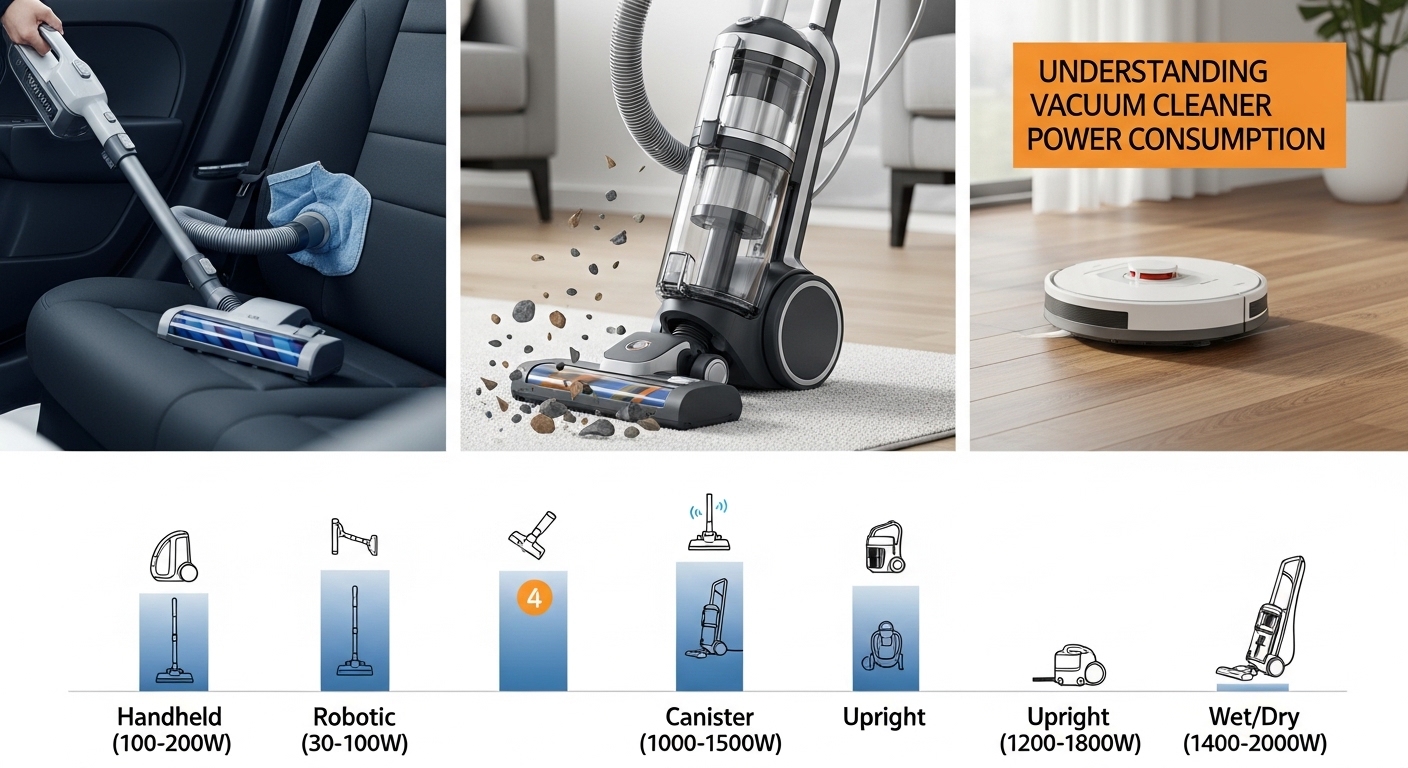
Ever stand there lookin’ at your vacuum cleaner and wonder, “wait… how many watts does this thing actually suck down?” Cause, honestly, you kinda wanna know if it’s gonna blow your electricity bill sky-high or just quietly hum while doin’ the job. I mean, we all got that moment where you’re vacuuming and thinking, hmm, is this little machine secretly a monster on power or nah? Turns out, the answer ain’t as straight as you might hope, and lemme tell ya, it depends on a bunch of stuff most people never think about.
Understanding Vacuum Cleaner Wattage
So first off, wattage is basically the amount of power your vacuum uses to operate. Like, it’s kinda the juice that makes it go “vrrrmmm” and suck all the crumbs outta your carpet. Most home vacuums sit somewhere between 500 watts and 1500 watts, but then there’s stuff like those big shop vacs or commercial vacuums that can go up to 3000 watts. Yeah, three thousand. That’s basically a small appliance army just in one machine.
But here’s the catch: just cause a vacuum says it’s 1200 watts don’t mean it’s super powerful. Wattage is more about the motor’s energy consumption, not necessarily how well it cleans. Some newer vacuums are low wattage but designed smartly so they clean like a beast while saving electricity. And honestly, energy efficiency can make a huge difference if you’re vacuuming every day.
Types of Vacuums and Their Watt Consumption
Not all vacuums are born equal, that’s for sure. Lemme break down a few types and what you’re usually looking at in wattage.
- Upright Vacuums: These are your standard, old-school home vacs. They typically use 800 to 1200 watts. Fancy models with HEPA filters or extra suction? Could be 1300-1500 watts.
- Canister Vacuums: These guys tend to be slightly less power-hungry, around 600 to 1200 watts. They’re easier to maneuver but sometimes don’t have the raw power of an upright.
- Stick Vacuums: These sleek little things, sometimes cordless, hover around 200 to 600 watts. You might be like, “so weak!” but they’re surprisingly decent for light cleaning. Battery life is usually more of a limiter than wattage.
- Robot Vacuums: Tiny but cunning. They mostly sip power, around 30 to 80 watts. But since they run longer and automatically, they still add up if you leave ‘em goin’ all day.
- Shop Vacuums / Wet-Dry Vacs: Heavy-duty monsters, these beasts can use 1200 to 3000 watts. Perfect for construction dust and big messes, but definitely not for a small apartment.
So yeah, the wattage varies a lot depending on what kinda vacuum you got and what it’s meant to do.
How Wattage Translates to Electricity Costs
Alright, so you’re probably wondering, “ok, but what does that actually mean for my bill?” Let’s do a lil math without making it too painful. Suppose you got a 1200-watt vacuum and you use it for 1 hour. 1200 watts is 1.2 kilowatts. Electricity bills are usually calculated per kilowatt-hour (kWh). So, 1.2 kWh times your local rate — say $0.15 per kWh — that’s about 18 cents. Not too bad, right?
But here’s where it gets sneaky: if you’re vacuuming an hour a day, every day, that adds up to roughly $5.40 a month. And if you got a super high-power model like a 2000-watt shop vac, same scenario jumps to like $9 a month. It’s not life-changing, but over a year, it’s noticeable, especially if you’ve got a bunch of appliances all running at once.
Suction vs Wattage – The Real Power Story
A lot of people assume higher watts = better cleaning. Not exactly. Wattage is the power the motor consumes, not the suction output. Suction is measured in air watts, which is a totally different thing. Air watts take into account airflow and pressure, which is what actually lifts dirt off your carpet. So a 900-watt vacuum designed smartly could beat a 1200-watt vacuum with poor design.
A quote from Consumer Reports backs this: “Motor wattage alone is not a reliable indicator of cleaning ability; airflow and design matter more.” Which basically means, don’t just buy a vacuum cause it says 1500W on the box thinking it’s the Hulk of vacuums.
Energy-Efficient Vacuums
These days, there’s a big push for vacuums that don’t guzzle electricity. You got brands advertising “energy-smart motors” and low watt consumption but still maintain strong suction. Some models can clean as good as a 1200-watt vacuum while only sipping 600-700 watts. Saves money, saves the planet, all that good stuff.
Here’s a quick list of tips if you wanna cut your vacuum power usage:
- Vacuum slowly instead of racing across the floor. More thorough, less repeated passes.
- Empty the bag or bin regularly – full bags reduce efficiency and make the motor work harder.
- Clean filters often – clogged filters = wasted energy.
- Choose vacuums with variable suction settings. Low for bare floors, high for carpets.
Real-World Examples
Just to give some perspective, here’s how different vacuum types stack up in terms of real electricity use:
| Vacuum Type | Wattage | Avg. Hourly Cost (at $0.15/kWh) | Notes |
|---|---|---|---|
| Upright | 1200 W | $0.18 | Standard home use, decent suction |
| Canister | 1000 W | $0.15 | Easy on furniture, versatile |
| Stick | 400 W | $0.06 | Light-duty, cordless often |
| Robot | 50 W | $0.0075 | Great for daily touch-ups |
| Shop | 2000 W | $0.30 | Big messes, heavy-duty |
It’s kinda funny when you look at it like this—your robot vacuum literally costs pennies to run, but it’s doing a whole lotta work over the month without you even noticing.
Other Factors Affecting Power Use
There’s more than just the wattage label. How you use your vacuum can actually change how much power it consumes. For instance:
- Surface type: Thick carpets need more suction, so motor ramps up slightly.
- Attachments: Using a brush for stairs or upholstery can make the vacuum use a tad more energy.
- Vacuum age: Old vacs often use more power for same cleaning because motors degrade and filters clog.
- Voltage variations: If your home’s electricity isn’t stable, motor might run less efficiently.
All this means two vacuums with the same watts on the box might actually pull different electricity in practice.
Bottom Line
So, when you’re asking “how many watts does a vacuum cleaner use,” the real answer is: it depends. Most home vacs hover between 500 and 1500 watts, robots sip tiny amounts, and shop vacs are energy-hungry monsters. But don’t get tricked into thinking higher watts automatically means better cleaning. Suction design, airflow, filters, and your vacuuming technique play a huge role too.
If you’re smart about your usage, pick a decent energy-efficient model, and maintain it, your vacuum can clean like a champ without turning your electricity bill into a horror story. It’s kinda wild when you think about it: these machines we just push around the floor are quietly guzzling (or sipping) power, and most of us never even check. Now you know, and next time someone asks, you can casually drop, “yeah, my upright is 1200 watts, but it cleans like 2000 thanks to design.” That’s street cred in vacuum geek circles, believe me.
In the end, it’s all about balance. Wattage tells you part of the story, but not the whole epic saga of dirt removal, energy consumption, and efficiency. Keep an eye on those watts, but also pay attention to how your vacuum actually performs—cause that’s what really counts in the messy, crumb-filled trenches of everyday home life.