

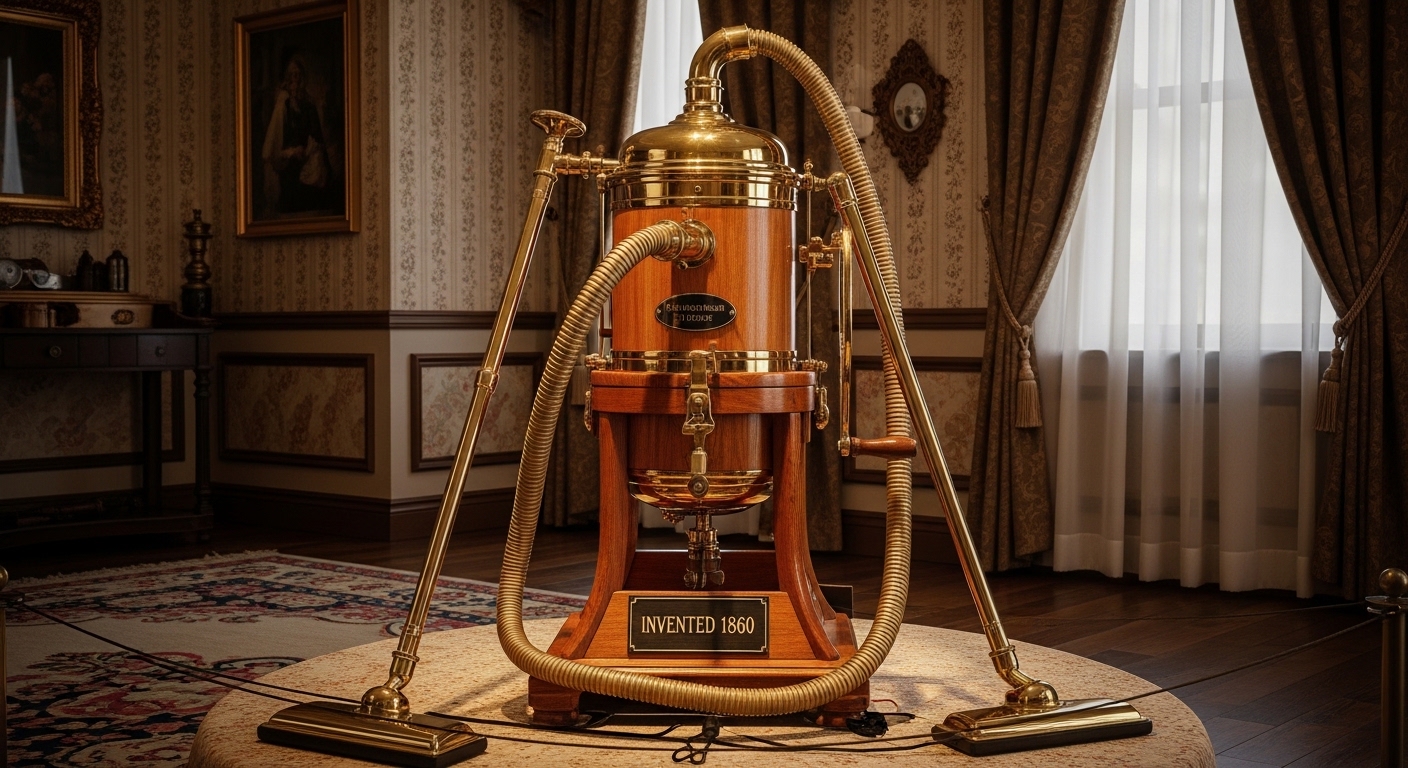
You might’ve been flipping through old photos or maybe standing in a dusty attic thinking “what year was the vacuum cleaner invented” — like me, scratching your head cause it’s just one of those things we take for granted but never really think about when it first showed up. You’ve used one a thousand times, probably shrugged every single time you plugged it in, but have you ever wondered how long humans were dragging dust around before someone said “okay, this is stupid, let’s build a machine for this”?
Let’s dive into that, but in a way that doesn’t sound like some robotic textbook. I’m gonna talk to you like we’re sitting over a coffee. And yeah, we’ll explore the actual year and all the twists and turns that led to that invention you probably never give much thought to but thank silently every time you clear up dog hair from the carpet.
The early, messy story that finally answers what year was the vacuum cleaner invented
Once upon a time — and I do mean waaaay back — nobody had vacuums. I know, duh, right? But listen: there was this long stretch where people were basically using brooms, cloths, their hands sometimes, and just swearing under their breath, because vacuuming was just a kid of future magic nobody had cracked yet.
Most history books will tell you that the vacuum cleaner we kind of recognize today was invented in 1901 — that’s the year that a clever fella named Hubert Cecil Booth designed a powered machine that really did suck dirt up, kinda like the machines you’ve used. But the story’s twisty, with other inventors playing around with similar ideas before and after. Sometimes those names and dates get tangled up, and even experts don’t always agree exactly how to credit them, but 1901 is generally marked as the moment the vacuum concept became real enough to matter.
So, wait — how did people clean before 1901?
You’ve gotta imagine, in like the 1500s to late 1800s, cleaning was a messy fight. I mean:
- Heavy rugs, horse hair carpets — just dragging a broom over that was like trying to sweep pebbles with a twig.
- Hearths and fireplaces dumped ash everywhere.
- Rugs were often taken outside and beaten with sticks — literally shaking dust into the wind.
- Some wealthy folks had “carpet beaters” that looked like giant fly swatters, and servants who had to wrestle with them for hours.
If you lived in those days, you’d probably think vacuum cleaners were some sort of witchcraft or sorcery. And hey, maybe you would call them that if you saw one for the first time.
The first real attempts: before the “official” vacuum
Now here’s where it gets kinda cool and confusing. People had ideas before 1901 that were sorta vacuum-y. Like:
- In the 1860s, a dude named Daniel Hess patented a machine that used bellows and brushes to kind of suck stuff up. It wasn’t powerful, and it wasn’t practical, but it had the basic idea — suction with a mechanism.
- Around the same era, Ives W. McGaffey patented something called a “sweeping machine” in 1869 that had a similar goal: get the dirt up without just pushing it around.
But honestly? These early contraptions were bulky, weak, and not really something you’d want in your home. They were basically prototypes — sketches of what would come later. So people can debate them, but when the world started using vacuum cleaners in a real way, that’s roundly pinned to the early 1900s.
Hubert Cecil Booth and the first “real” vacuum
Our answer to what year was the vacuum cleaner invented typically settles around 1901 because that’s when Hubert Cecil Booth, a British engineer, designed, built, and demonstrated a machine that worked on suction in a meaningful way. Gone were the flimsy, awkward bellows contraptions. Instead, Booth’s machine was powered by an engine and had a hose long enough to clean floors far from the engine itself.
Here’s some stuff that gets glossed over but matters a lot:
- Booth’s design was big — like, horse-carriage sized big. You couldn’t put it in your living room.
- It was powered by a petrol engine and then later electric motors as those became more available.
- Because of its size, workers had to bring it outside buildings and snaked hoses inside through windows.
So tell me this: ever used a vacuum that you had to park outside first? Didn’t think so.
Here’s a mini snapshot of that pivotal year:
| Year | Inventor | Contribution |
|---|---|---|
| 1860s | Daniel Hess | Early suction idea with bellows |
| 1869 | Ives W. McGaffey | First sweeping machine patent |
| 1901 | Hubert Cecil Booth | First practical, powered vacuum concept |
| Early 1900s | Various inventors | Smaller, electric, home‑friendly versions begin |
See how 1901 stands out? That’s why most historians go with that year when answering what year was the vacuum cleaner invented. Not cause it snapped into existence fully formed, but because that’s where the story really starts having impact.
What changed after 1901
Once Booth showed the world that suction machines could work, the floodgates opened. Over the next couple decades:
- Engineers started shrinking the machines.
- Electricity became widespread, especially in cities, so vacuums got smaller and plug‑in friendly.
- Brands we know today began popping up with designs that looked more like what you’d recognize — upright cleaners, canister types, handhelds.
By the 1920s and 1930s, households in the U.S., UK, and Europe were starting to see vacuums that were practical. They weren’t perfect, but they sure beat hauling rugs outside every weekend.
Real‑world example
My grandma used an old upright vacuum when I was a kid — you know, the kind that’s somewhere between a suitcase and a tank, with chunky wheels and a filter bag inside. She once told me it was basically the same design her mom had back in the 1930s, just a bit more powerful and lighter. And think about that: within 30 years of that first powered 1901 machine, people had cleaned up these designs so regular folks could use them without calling a crew.
That’s nuts when you realize how fast that happened for those times.
Some fun facts you probably didn’t know
People will toss around trivia like it’s confetti, but some of it’s actually kinda wild:
- The word “vacuum” itself comes from Latin vacuus, meaning “empty” — fitting, but think about how weird of an idea that was back then.
- Early vacuum machines were sometimes called suction cleaners. You’ll see that term in old ads and newspaper clippings.
- There were vacuum cleaner races in the 1920s. Yes, actual races. People souped‑up motors trying to prove whose machine could not only clean floors but go the fastest. Honestly, humans are weird.
Looking at dirty floors today vs back then
If you’ve ever paused while vacuuming and cursed at how much dust came up, just imagine doing that without an appliance. Before vacuum cleaners became mainstream:
- Carpets were beaten outdoors.
- Animal hair and dust were brushed into piles.
- People used rugs and mats outside to try to catch some of the filth before it got in.
And now? You plug in, zip around, empty a little bag or canister. Whole different world.
Answering your question again, but with layers
So let’s revisit it: what year was the vacuum cleaner invented? The cleanest answer — the one most people agree on — is 1901, because that’s when the first practical powered machine was created by Hubert Cecil Booth that wasn’t just a quirky idea but a functioning device.
But if we widen our lens, say we want to include things that led to that moment, you could throw out earlier patents from the 1860s and 1869 as stepping stones. They’re in the family tree, but they aren’t quite the full deal.
Okay, so why does this matter?
You might be thinking “it’s just a vacuum.” But that’s exactly the point — it is, and it’s not just. When you unpack what year it was invented and how it came to be, you see a story of human frustration turning into innovation. Someone got fed up with dust. Someone looked at a carpet covered in grit and said, “nah, there’s got to be a better way.”
And that moment of frustration is something every single person who’s ever pulled hair out of a brush or yanked crumbs from a couch cushion understands. It’s universal. That’s why knowing its history feels more personal than memorizing some random date.
Final breakdown
Here’s a concise recap so it sticks with ya:
- Before 1901: Lots of attempts, mostly impractical.
- 1901: Hubert Cecil Booth builds a machine that actually works — this is the year most agree answers what year was the vacuum cleaner invented.
- Early 1900s onward: Designs improve, electrics make them home‑friendly, and soon your grandparents had something that looked familiar to what you use today.
So next time you plug in your vacuum, take a second to think about that long winding journey from beating rugs outside to this sleek gadget humming beneath your hand. It’s kind of wild how far we’ve come.
Let me know if you want to go deeper into the evolution of home tech or how vacuum cleaners changed other things like carpet design or house building. There’s more fun history in there than you’d expect.