

You know that odd moment when you’re staring down at dust bunnies under your couch thinking, why on earth did someone ever invent the vacuum cleaner? That exact thought — or something like it — led to the earliest machines that tried to solve the same problem you’re stuck with right now. The question of when was vacuum cleaner invented doesn’t have a single neat answer, but it has a timeline that’s pretty wild once you dive into it, and in this article we’ll set out all the twists and turns of how that dusty idea became the thing you drag around your living room.
Some people think the vacuum cleaner popped out of nowhere, but it’s more like a slow march of ideas that piled up into today’s sleek robots and stick vacs. So grab a seat, relax your shoulders (maybe check under the sofa later), and let’s walk through the history that leads straight to the modern vacuum.
Early Scrubbers and Sweepers: The 1860s
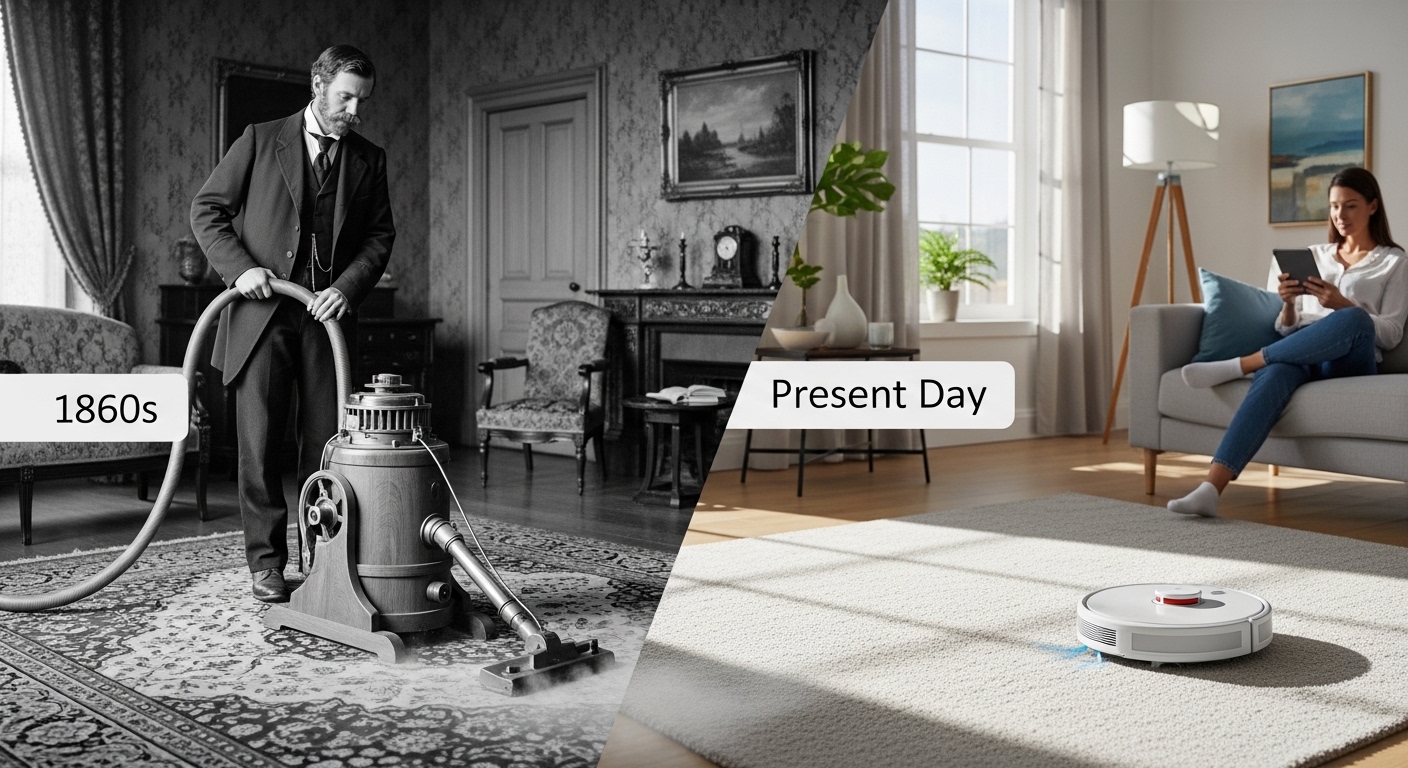
The real story of when was vacuum cleaner invented begins much earlier than most people imagine — back in 1860, right in the middle of the Industrial Revolution in America. An inventor named Daniel Hess from West Union, Iowa patented a machine he called a carpet sweeper. It wasn’t a vacuum in the way you understand it now, but it did use bellows — sort of big squeezable air pumps — to create suction, and it had a rotating brush to pull up dust. Hess’s patent (U.S. No. 29,077) described a mechanism that actually pulled dirt through the machine by means of an air draft, which is basically the core idea behind every vacuum today.
Whether you’d call that the first vacuum cleaner depends on how strict you want to be about definitions. But if your question is about when was vacuum cleaner invented in the sense of first attempting suction cleaning, that 1860 invention is where we have the earliest recognized patent.
Just a few years later — in 1868 — another inventor named Ives W. McGaffey from Chicago got a patent for a machine called the Whirlwind. This contraption used a hand-cranked, belt-driven fan to pull dust into a receptacle by suction. It was awkward and heavy, but it did work better than a broom.
There were other sweepers thrown into the mix too — in 1876, Melville R. Bissell (yes, that Bissell) developed a sweeper that cleaned carpets with a rolling brush activated by the wheels. It didn’t have powered suction yet, but it was another step in the evolution.
So already by the late 1860s and 1870s, people were experimenting with machines that did something much more interesting than just sweeping — they were trying to move dirt with air.
The Big Leap: Powered Suction Comes to Life (1901)
Now here’s where the vacuum really starts to look like something recognizable: 1901. That’s the year British engineer Hubert Cecil Booth patented what’s widely thought to be the first motorized suction cleaner using real suction power. His machine was nicknamed “Puffing Billy.” It was enormous — so big that it had to be mounted on a horse‑drawn wagon, complete with an internal combustion engine driving the suction.
According to Booth’s own accounts, he got the idea after watching a machine that tried to blow dirt rather than suck it out. He thought: why not reverse the idea and pull the dust out? So he designed a suction system powerful enough to remove dirt through hoses. That was a completely different mindset from anything before.
At roughly the same time — 1901 as well — American inventor David T. Kenney independently came up with a suction cleaner driven by a steam engine with pipes reaching throughout a building, showing that multiple minds were circling the same idea of powered cleaning.
But let’s be honest, neither of these early machines were anything like the portable cleaners you’ve dragged out of a closet. Booth’s Puffing Billy was impressive, but it was more of a service machine — technicians would park it outside and run hoses into the mansion or business they were cleaning.
The First True Portable Vacuum (1907–1908)
If you’ve ever wondered when was vacuum cleaner invented in the form we’d actually recognize, the answer really takes shape around 1907–1908 with James Murray Spangler. Spangler was a janitor in Canton, Ohio, whose asthma was made worse by sweeping dusty floors, so he tinkered around and built a prototype combining an electric fan motor, a rotating brush, a box, and — famously — one of his wife’s pillowcases as the dust bag.
In 1908 he patented this “Electric Suction Sweeper” — a portable, electrically‑powered vacuum that actually worked and could be used by ordinary people in their homes. That’s a big moment in the story of when was vacuum cleaner invented in a way that really mattered for everyday life.
Spangler didn’t have the money to mass-produce his design, though, so he sold the patent to a local leather goods maker, William Henry Hoover, who saw the potential right away. Hoover redesigned the machine with a steel casing, wheels, stronger motors and a removable bag system, and soon started selling what would become the iconic Hoover vacuum cleaners.
From that point — the early 1910s into the 1920s — vacuum cleaners shifted from novelties and commercial machines to must-have household appliances, especially as electricity became more widespread in homes.
Vacuum Cleaner Evolution After the First Inventors
Here’s a short timeline showing how the vacuum cleaner evolved after those landmark moments:
- 1905 – Walter Griffiths in Birmingham made a more portable vacuum cleaner, powered by a human and resembling modern shape.
- 1906 – James B. Kirby created the Domestic Cyclone, a vacuum using water to separate dirt.
- 1910 – Denmark’s Fisker & Nielsen was among the first companies to sell consumer vacuum cleaners in Europe.
- 1920s – Disposable filter bags became a big innovation in the U.S., making cleaning easier.
- 1921 – Electrolux entered the US market with its Model V, a vacuum that could slide on metal runners across the floor.
Across these decades the tech kept getting smaller, lighter, and easier to use — exactly the kind of thing grandma tucked in her linen closet by the 1950s.
Why This History Matters
Looking at when was vacuum cleaner invented shows a pattern that’s actually kind of inspiring. It’s not just one genius moment — it’s a sequence of people, ideas, prototypes and improvements that built something ordinary (dust removal) into something extraordinary (a device that changed the way we live). The vacuum cleaner’s story highlights how inventions are often evolutionary, not instantaneous.
And get this: over time the idea of vacuum cleaning didn’t stop at big upright machines — modern tech now includes robotic cleaners that vacuum your floors while you sleep, and ultra‑compact stick models with cyclonic suction technology that would amaze the earliest inventors.
Wrap‑Up: So When Was the Vacuum Cleaner Invented?
So if you really want a straight answer to when was vacuum cleaner invented, here’s the simplest summary:
- The first attempt at a suction‑style carpet cleaning machine was Daniel Hess’s 1860 carpet sweeper.
- The first motorized suction vacuum was patented by Hubert Cecil Booth in 1901.
- The first truly practical portable electric vacuum cleaner was patented by James Murray Spangler in 1908, and became widely used when William Hoover commercialized it.
So it wasn’t ever just one moment — but a journey of ideas from rough sweepers to the powerful, quiet machines you push around today. Every time you grab the handle and switch it on, you’re holding more than a tool — you’re holding a history that stretches back nearly 170 years.
Now maybe go check under the couch… you might find some history of your own there.